Gear breakage in a hydraulic gear pump is usually blamed on overload or a defective part. In low-pressure applications, the cause can be the opposite: the pump is running at a pressure far below what its internal design expects. Standard gear pumps are assembled with tightly packed bushings. They rely on operating pressure to separate slightly and give the gears room to turn freely. If the pressure is too low, and especially if the displacement is very small, that clearance never forms. Friction then builds until the gears fail.
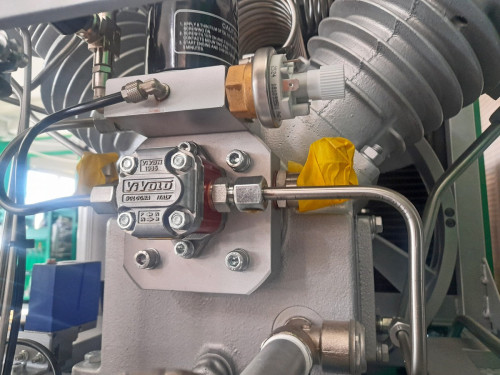
The fix is rarely a bigger or "stronger" pump. It is a pump configured for the actual working pressure. A case documented by Vivoil, whose gear pumps Hydrapac Italia stocks, shows how a customized standard Vivoil group 0 unidirectional gear pump ended repeated gear failures in a lubrication circuit running below 5 bar.
In a standard Vivoil gear pump, the bushings are intentionally tightly packed. A compensation section of the seal holds them against the gears. Under normal operating pressure, fluid pressure pushes the bushings slightly apart, so the rotating parts can move freely.
At very low pressure combined with a small displacement, that separation does not happen. The gears run with too much friction, and that friction can break them, even when the pump is in perfect working order and correctly sized for the flow.
The result looks like a product failure, but the real problem is that the pump doesn't suit the operating conditions.
The customer manufactures high-pressure multi-stage reciprocating compressors. These machines use splash lubrication as standard: the crankshaft dips into the crankcase oil and sprays it onto the cylinder liners.
An optional version adds forced lubrication for the hardest point to reach, the final-stage liner:
The Vivoil pumps fitted to this circuit suffered gear breakage shortly after entering service. The pumps were in perfect working order and correctly sized for the circuit. When Vivoil's engineers reviewed the application data, they found the cause: the pumps were working at under 5 bar. Standard Vivoil pumps are tested to operate at 250–300 bar.
The pump used was the smallest displacement in the Vivoil range, 0.17 cm³/rev. That combination of very low pressure and very small displacement is the one most likely to cause the problem.
Vivoil did not design a new pump. It customized a standard model by removing the internal compensation section of the seal, the element that keeps the bushings tightly packed. With that section removed, the bushings stay slightly separated, so the gears turn freely even at very low pressure.
The customer tested the modified pumps and confirmed that the issue had been permanently resolved.
| Specification | Value |
|---|---|
| Custom model | Vivoil 7P0101001 |
| Base standard model | Vivoil X0P0101ABBA |
| Pump type | Unidirectional gear pump |
| Size group | Group 0 |
| Displacement | 0.17 cm³/rev |
| Operating pressure in application | Below 5 bar |
| Modification | Internal compensation section of the seal removed |
The risk is highest wherever a small-displacement gear pump works far below the pressures it was designed and tested for. Typical cases are lubrication and oil-circulation duties on compressors, engines and other machinery, where the pump moves oil rather than building system pressure.
If you see gear breakage on a pump that is correctly sized and shows no signs of overload, check the real working pressure before ordering another identical replacement.
Most low-pressure gear failures can be prevented at the ordering stage. The intended use is not always passed on when components are ordered, so the pump supplied is a standard version built for standard pressures. When you request a quote, include:
With this data, the manufacturer can confirm whether a standard pump fits. If it doesn't, they can propose a customized version of a standard model, which is usually quicker than a fully custom design.
Hydrapac Italia keeps a wide range of Vivoil gear pump groups and models in stock for OEMs, machine builders, maintenance teams and distributors. When a standard pump doesn't suit the duty, we can also order customized Vivoil pumps. Send us your application data, including the real working pressure, and we will check it with Vivoil so you get the right pump the first time: a standard model from stock, or a customized version built for low-pressure duty.
Hydrapac Italia wide range of Gear pumps
Yes. In standard gear pumps the bushings are tightly packed and rely on operating pressure to separate slightly. At very low pressure they stay packed, the gears run with excessive friction, and they can break.
The problem appears when very low pressure is combined with a small displacement. In the Vivoil case, a 0.17 cm³/rev pump working below 5 bar suffered gear breakage shortly after entering service.
Standard Vivoil pumps are tested to operate at 250–300 bar. A pump working below 5 bar is far outside that range.
Not necessarily. In the documented case, Vivoil customized a standard group 0 unidirectional pump (base model X0P0101ABBA) by removing the internal compensation section of the seal. The result was custom model 7P0101001.
State the actual operating conditions, especially the working pressure when it differs significantly from standard values, and describe the application. This lets the manufacturer confirm whether a standard pump is suitable or propose a customized one.
Vicolo del lavoro, 9 40069 Zola Predosa (BO) Italy
Phone : +39 051 755082 - Email : .(JavaScript must be enabled to view this email address)
C.F e P.IVA : IT 02423401203 - R.E.A. 438331
Share capital: €10.000,00 i.v.
Credits: Lincolnpixel Web Agency
© 2026 Hydrapac Italia, Inc. All rights reserved.